
The CMA's public cautions
Key facts
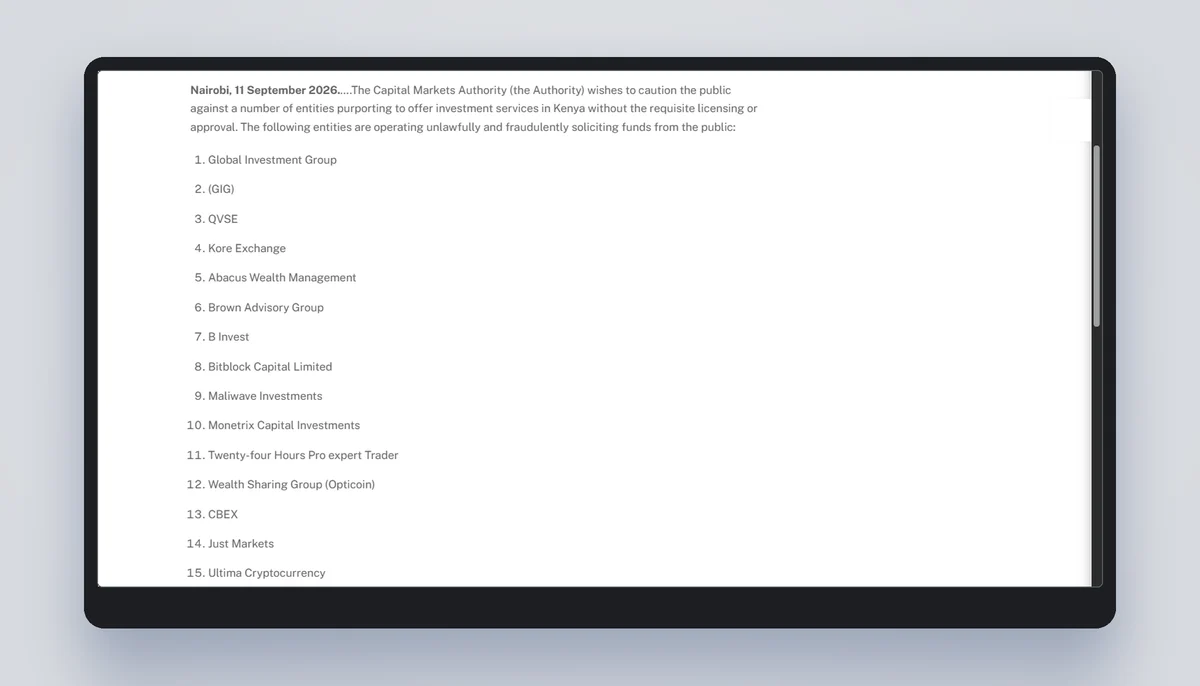
The Capital Markets Authority publishes cautions and notices about entities it says are not licensed to carry on capital-market activities in Kenya. The table below shows each caution exactly as the source wrote it: the name, the date of the release, the kind of row, and a link to the release. A row records what the source published, not a finding of this site.
CMA public cautions
The entities named in the CMA's release of 11 September 2026, with the date of the release.
| Name as the CMA's release gives it | Date of the release | Kind | Source |
|---|---|---|---|
| September 2026 | |||
| Abacus Wealth Management | 11.09.2026 | Entity named in a public caution | CMA ↗ |
| B Invest | 11.09.2026 | Entity named in a public caution | CMA ↗ |
| Bitblock Capital Limited | 11.09.2026 | Entity named in a public caution | CMA ↗ |
| Brown Advisory Group | 11.09.2026 | Entity named in a public caution | CMA ↗ |
| CBEX | 11.09.2026 | Entity named in a public caution | CMA ↗ |
| Global Investment Group (GIG) | 11.09.2026 | Entity named in a public caution | CMA ↗ |
| Just Markets | 11.09.2026 | Entity named in a public caution | CMA ↗ |
| Kore Exchange | 11.09.2026 | Entity named in a public caution | CMA ↗ |
| Lukman-trust fund | 11.09.2026 | Entity named in a public caution | CMA ↗ |
| Maliwave Investments | 11.09.2026 | Entity named in a public caution | CMA ↗ |
| Monetrix Capital Investments | 11.09.2026 | Entity named in a public caution | CMA ↗ |
| QVSE | 11.09.2026 | Entity named in a public caution | CMA ↗ |
| Twenty-four Hours Pro expert Trader | 11.09.2026 | Entity named in a public caution | CMA ↗ |
| Ultima Cryptocurrency | 11.09.2026 | Entity named in a public caution | CMA ↗ |
| Wealth Sharing Group (Opticoin) | 11.09.2026 | Entity named in a public caution | CMA ↗ |
What a CMA caution is
A CMA caution is a public statement that an entity is not licensed or approved to carry on capital-market activities in Kenya. It may name an entity, a website, or a type of activity. The Authority publishes these cautions so that the public can see which platforms it has warned about.
The caution is the regulator's act, not this site's verdict. This site does not call any entity a scam or a fraud. It shows the caution as the source published it, with the date the source gave.
The columns of the table
The table above has one row for each entity named in a CMA caution release. At the latest reading that is one release, dated 11 September 2026, naming fifteen entities. The first column shows the name exactly as the source wrote it. The second column shows the date of the release. The third column shows the kind of row; here every row is an entity named in a public caution. The fourth column is a link to the release on the CMA website.
A reader should open the link and read the full text. The table is a pointer to the source, not a substitute for it. The source may contain details that the table does not show.
How to use the cautions in a check
When checking a platform, take the exact legal name from its terms and conditions, not the brand in an advert. Search that name in the caution table. A caution may also name a website or a type of activity, so search for those too.
A caution that names a similar name is not the same as a caution that names the exact entity. A reader should compare details carefully. If in doubt, open the original notice and read what the Authority said.
What a caution does not say
A caution does not say that an entity has committed a crime. It says that the entity is not licensed or approved by the CMA. The Authority may issue a caution for many reasons, including that an entity is soliciting Kenyan investors without a licence.
A caution also does not say that an entity is safe if no caution exists. The absence of a caution means only that the CMA has not published one. It is not a licence.
Reading the date of a caution
The date in the table is the date of the CMA release that names the entity. A caution may be older than the platform's present form. An entity may change its name, website, or the products it offers. A reader should check the current details of the platform against the caution.
The date also matters because the Authority may publish new cautions at any time. The table shows the reading whose date is printed under it, so a caution published after that reading will not appear until the table is read again.
What to do after reading a caution
If a platform you are considering appears in the caution table, read the full notice on the CMA website. Compare the details: the name, the website, the activity. If they match, you have the regulator's own statement that the entity is not licensed.
If you have already sent money to a platform named in a caution, the next step is to report to the relevant body. The page on where to report explains who receives what in Kenya.
A caution can cover an entity that uses many trading names
The CMA sometimes publishes a caution that names one legal entity but lists several brand names or websites under it. Readers who know only the trading name may miss the caution if they search the table for that exact name. The table on this page includes the names exactly as the CMA wrote them, so a brand may appear as its own row or only inside a longer entry.
When checking a platform, do not stop at the brand name you saw in a WhatsApp group. Open the full caution text where the CMA provides it and look for other names the same people use. A single caution can connect many fronts to one operator, and that link is often the most useful part of the regulator's notice.
If you find a brand inside a caution for a different legal entity, treat the brand as cautioned. The CMA does not maintain a separate list of trading names, so the legal entity is the anchor. A platform that changes its display name but keeps the same company behind it remains under the same caution.
A caution may be published after people have already lost money
The CMA's cautions are reactive in many cases. The regulator often learns about an unlicensed platform after receiving complaints from the public. By the time a caution appears, some Kenyans may have already deposited funds and found they cannot withdraw them.
This timing matters because readers sometimes use the caution table as a first check before sending money. It is better to check before any deposit, but the table cannot prevent losses that happened before the CMA acted. A caution that appears today may describe a platform that has been soliciting Kenyans for weeks or months.
When you see a new caution, treat it as a signal that the CMA has confirmed a problem, not as the start of the problem. If you have already dealt with the entity, the caution tells you to stop and report. The table is not an early warning system; it is a public record of the regulator's findings.
A caution does not freeze the platform's ability to receive M-Pesa
The CMA can publish a caution, but it cannot directly block a platform from receiving money through M-Pesa. Payment services operate under different regulators, and a caution alone does not stop a paybill or till number from working. Readers sometimes assume that a caution means the platform is shut down; it is not.
An unlicensed platform can continue to advertise in WhatsApp groups and accept M-Pesa deposits after the CMA has warned the public. The caution is a notice to you, not a technical block on the platform's operations. Enforcement may come later through other channels.
This gap explains why the site recommends reporting to the CMA and other bodies. A caution is one step in a longer process. The platform may keep operating until a formal order is issued or the payment service provider acts. Your own refusal to send money is the most immediate protection.
The CMA can caution an entity that is licensed in another country
A platform may hold a licence from a foreign regulator and still be cautioned by the CMA. Kenya's capital markets law requires a licence from the CMA to offer certain services to Kenyans, regardless of what permissions the platform has elsewhere. The caution table can include such entities.
Readers sometimes see a foreign licence and assume the platform is safe in Kenya. That assumption is wrong. The CMA cautions unlicensed activity in Kenya, not the platform's status in its home country. A licence from another jurisdiction does not exempt a platform from Kenyan rules.
When checking a platform, look for the CMA licence first. A foreign licence is not a substitute, and a caution may exist precisely because the platform relied on its overseas status while soliciting Kenyans. The table records the CMA's view of the platform's standing in Kenya.
The caution names the entity, not the app or the paybill
A CMA caution identifies the legal entity or the trading name the authority has investigated. It does not always name the mobile app, the website domain, or the M-Pesa paybill number that the platform uses to collect money. A platform can run several apps and change paybill numbers while the legal entity stays the same. The caution may not list every name the platform has used.
This creates a practical failure mode. A reader checks the app name, finds nothing in the caution table, and concludes the platform is not cautioned. The caution may be filed under a holding company or a different trading name. The platform may have moved to a new paybill number that is not mentioned anywhere in the caution. The table's search works best when you know the exact legal name the platform uses in its terms and conditions.
The order of operations should be to start from the platform's own documents, not from the name in the advertisement. The terms of service or the deposit screen will state the legal entity that operates the platform. That is the name to check against the caution table. The name in the WhatsApp message is often a marketing label that the authority has never published.
A caution does not cover every unlicensed platform in Kenya
The CMA publishes cautions for entities it has reviewed. It does not publish a caution for every unlicensed platform operating in Kenya. The authority has limited resources and chooses which cases to investigate and publicise. A platform may be unlicensed and still not appear in the caution table because the CMA has not yet issued a caution for it.
This is the distinction readers get wrong most often. They treat the caution table as a complete list of unlicensed platforms. In reality, the table is a partial list, updated when the CMA acts. A platform that is not in the table is not necessarily licensed. It may simply be unknown to the authority or under review without a public caution yet.
The check therefore has two steps. First, look for the platform in the caution table. If it is there, the CMA has already warned about it. If it is not there, look for the platform in the CMA's list of licensees. Absence from both tables means the platform is not licensed, whether or not a caution has been published. The absence of a caution is not a signal that the platform is safe.
A caution can appear long after the platform starts operating
The CMA publishes a caution when it has gathered enough detail to act. That can take time. A platform may have been taking money from Kenyans through M-Pesa for many months before its name reaches the caution table. The date on a caution is the date of publication, not the date the platform first appeared.
This gap matters for anyone checking a platform they have already used. A clean check against the caution table on a given day tells you only what the CMA had published by that day. It does not tell you that the CMA has examined the platform and found nothing worth cautioning about. Regulators often move after complaints accumulate.
The practical check is to look at the caution table again after any gap in your dealings with a platform. A platform that was absent from the table in one month can appear in the next. The CMA does not send personal alerts, so the burden of rechecking falls on the reader. Treat the table as a living list, not a one-time filter.
Read next
Quick questions from Kenyan readers
What is a CMA caution?
A CMA caution is a public statement that an entity is not licensed or approved to carry on capital-market activities in Kenya. It may name an entity, a website, or a type of activity. It is the regulator's act, not a court finding.
How current is the caution table?
The table is built from one reading of the CMA website, and its date is printed under the table. A caution published after that reading will not appear until the table is read again; this site does not run on a schedule. The date shown is the date of the CMA release.
Does a caution mean an entity is a scam?
No. A caution says only that the entity is not licensed by the CMA. It does not say the entity has committed a crime. This site does not call any entity a scam or a fraud.
What if a platform is not in the caution table?
The absence of a caution means only that the CMA has not published one for that exact name. It does not mean the platform is licensed, safe, or appropriate for any reader.
Where can I read the full caution?
Each row has a link to the original on the CMA website. Open the link and read the full text. The table is a pointer to the source, not a substitute.
Before you open an account
If you are considering an international CFD broker, the same checks apply: find the legal entity in the client agreement, search the regulator's register it names, and read the risk warning. An account carries a high risk of losing the money deposited.