
Online forex in Kenya
Key facts
Kenya has rules for online foreign exchange trading, made by the Capital Markets Authority. They cover licensed brokers. An overseas platform soliciting Kenyans is a different situation. This page explains what to ask a forex platform for, in words, without citing regulation numbers or dates.
Kenya's rules for online forex
The Capital Markets Authority has rules for online foreign exchange trading. These rules cover brokers that are licensed by the CMA. A licensed broker must meet the conditions set out in the rules, including how it handles client money and what it discloses.
The rules do not cover every platform that advertises forex trading to Kenyans. An overseas platform may be regulated elsewhere, or not at all. The fact that a platform accepts Kenyan clients does not mean it is covered by Kenya's rules.
An overseas platform soliciting Kenyans
An overseas platform that solicits Kenyan investors is a different situation from a CMA-licensed broker. The overseas platform may be regulated by another authority, such as one in Europe or the Caribbean. That regulator's rules apply, not the CMA's.
A platform's website may be in English and accept M-Pesa, but that does not make it Kenyan. The legal entity behind the platform, and the regulator it names, determine which rules apply. A reader should ask for both in writing.
What to ask a forex platform for
Before paying a forex platform, ask for its legal entity, its licence category, and its regulator. The legal entity is the company named in the client agreement, not the brand. The licence category tells you what the entity is authorised to do. The regulator is the authority that issued the licence.
If the platform does not give these in writing, that is a gap. A legitimate platform should be able to name its legal entity and regulator. If it refuses, consider that a warning sign.
Checking the answers
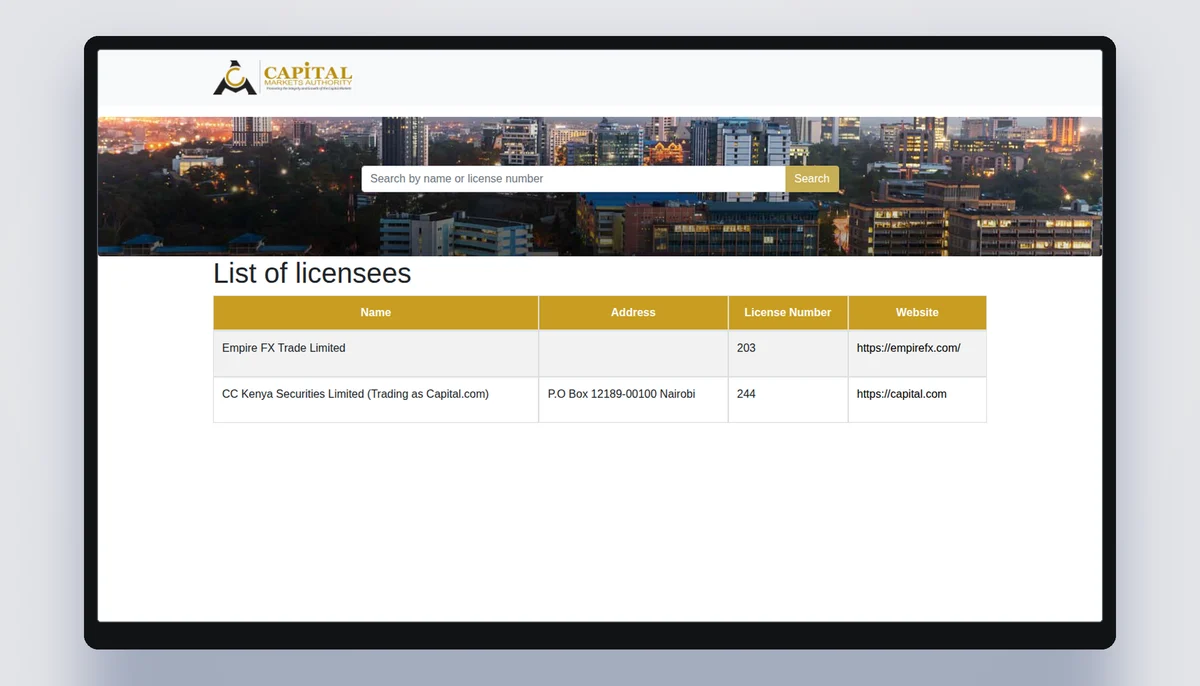
Once you have the legal entity and regulator, check them. If the regulator is the CMA, search the CMA licensee list for the exact name. If the regulator is another authority, search that authority's register. The check is the same: exact name, category, and status.
A platform may name a regulator but not be on its register. That is a reason to be cautious. The register entry should match the legal entity and the category. If it does not, ask the platform to explain.
What a licence does not promise
A licence, whether from the CMA or another regulator, does not promise profit or safety. Forex trading is risky, and a licensed broker can still lose a client's money. A licence means the broker is permitted to offer the service, not that the service is suitable for every reader.
A reader should read the risk warning before opening an account. The risk warning states the possibility of losing money. No licence removes that risk.
M-Pesa as a payment rail
M-Pesa is a payment rail, not a regulator. The fact that a forex platform accepts M-Pesa says only that it has an arrangement with a payment provider. It does not show that the platform is licensed, or that the money is protected.
A payment sent by M-Pesa to an unlicensed platform may be difficult to recover. The page on where to report explains who to contact if you have sent money.
The CMA's online forex rules create two classes of platforms
Online forex in Kenya is not a single activity in the eyes of the Capital Markets Authority. The regulator separates platforms that offer leveraged foreign exchange contracts from platforms that simply let a person buy and hold foreign currency. The first class is treated as a derivative product, which requires a licence. The second class is treated as a money service, which is not under the CMA at all.
This split catches many first-time users. A platform may advertise itself as a place to buy dollars or euros, but its terms allow a customer to open a position far larger than the money they sent. That is leverage, and it is the marker that pushes the service into the derivative class. The platform's own wording is not decisive; the CMA looks at what the product actually does.
Before paying a platform, a reader should ask which class the product falls into. If the answer is leveraged forex, the platform must name its CMA licensee. If the answer is a currency exchange, the CMA's list is the wrong place to check, and the platform should point to a different licence, such as one from the Central Bank of Kenya for a money remittance provider.
A foreign regulator's approval does not travel to Kenya
Many online forex platforms show a licence from a well-known offshore regulator. They may display a registration number from a Caribbean island, a European member state, or a Middle Eastern free zone. A Kenyan reader could reasonably assume that this approval covers them. It does not. The Capital Markets Authority treats a foreign licence as evidence of a foreign regulator's decision, not as a Kenyan authorisation.
The CMA's own licence list is the only list that matters for a platform soliciting Kenyan residents. A platform that is licensed in another country but not in Kenya is still unlicensed for the Kenyan market. This is not a technicality; it affects every step of the relationship. The contract may be governed by foreign law, disputes may have to be filed in a foreign court, and the CMA may have no power to investigate the platform's conduct.
A reader should therefore ask for the Kenyan licence, not any licence. If the platform produces a foreign document, that is a useful sign that the platform has not completed the Kenyan process. The next question is whether the platform has an exemption or a no-action letter from the CMA, which is a separate matter from a full licence.
The legal entity behind a trading name is what gets checked
Forex platforms rarely use their registered legal name in their marketing. They use a brand, a domain name, or a WhatsApp display name. The CMA's licensee list and its caution list both use the legal entity name, which is the name on the certificate of incorporation. This creates a common failure: a reader checks the brand name against the CMA's list, finds nothing, and concludes the platform is unlicensed. That conclusion may be right, but the check was wrong.
The correct order is to ask the platform for its full legal entity name and its CMA licence number. That request should be made in writing, such as an email or a saved chat message. The platform's answer then becomes the string that is compared against the CMA's list. If the platform refuses to give a legal entity name, the check stops there, because there is nothing to compare.
A platform can have a trading name that sounds similar to a licensed entity's name. That similarity means nothing on its own. Only the exact legal name, word for word, matters. A reader who skips this step and relies on the brand name may miss a licence that exists or, more often, may believe a licence exists when it does not.
M-Pesa does not carry a licence signal
A platform's ability to accept M-Pesa payments is not evidence of any regulatory approval. M-Pesa is a payment rail, like a bank transfer or a card network. The payment provider moves money from a customer to a merchant account. The payment provider does not check whether the merchant holds a CMA licence, and it does not vouch for the merchant's product.
This means an unlicensed forex platform can accept M-Pesa as easily as a licensed one. The platform only needs a paybill or till number, which is a routine business service. The presence of an M-Pesa option on a platform's deposit page should therefore be treated as neutral. It tells the reader nothing about the platform's legal status in Kenya.
The same applies to other payment methods. A platform that accepts cards, bank transfers, or mobile money from another network is not made safer by that fact. The only signal that matters is the platform's legal entity name appearing on the CMA's licensee list for the specific activity of online forex. The payment method is a separate question about how money moves, not about who is allowed to offer the product.
A caution can name a platform that is still taking money
The CMA's public cautions are notices that an entity is not licensed. A caution does not order the entity to stop operating, and it does not block the entity's payment channels. A platform that has been cautioned can continue to advertise, accept M-Pesa, and open new accounts. The caution is a warning to the public, not an enforcement action against the platform.
This distinction explains why a reader may see a cautioned platform still active in WhatsApp groups. The CMA has published a notice, but the platform has not been shut down. The platform may be operating from outside Kenya, or it may be using a new trading name. The caution remains a useful piece of evidence, but it is not a guarantee that the platform has stopped soliciting Kenyans.
When a reader finds a caution, the practical step is to stop paying the platform and to report the platform to the CMA. The report adds to the regulator's file and may lead to further action. But the reader should not assume that the caution alone has closed the platform. The caution is a public statement, and the platform may ignore it.
A platform's refusal to answer basic questions is itself an answer
Before paying a forex platform, a reader should ask for three things: the full legal entity name, the CMA licence number, and the address of the entity's registered office in Kenya. These are not requests for confidential information. A licensed platform will have all three on file with the CMA, and a compliance officer can provide them without delay.
If a platform refuses to give this information, or gives only a brand name and a phone number, that refusal is a finding. It means the platform is not willing to identify the legal person that would hold the customer's money and sign the contract. A reader who proceeds anyway is dealing with an unknown counterparty, which is a risk that no licence check can remove.
The same applies to evasive answers. A platform that says its legal entity is 'the company' or 'our group' is not answering the question. A platform that gives a name but no licence number is also not answering. The reader should treat any incomplete answer as a reason to stop the process and look elsewhere.
Reporting a platform does not require proof of loss
A reader does not need to have lost money to report a platform to the Capital Markets Authority. The CMA accepts reports about unlicensed activity, suspicious solicitations, and platforms that refuse to identify their legal entity. The report can be made by email, through the CMA's website, or by phone. The reader does not need to be a customer of the platform.
The report should include the platform's trading name, its website or WhatsApp number, and any messages the platform sent. If the platform gave a legal entity name or a licence number, that should be included too. The CMA will compare the report against its own records and decide whether to open a file. The reader may not receive a personal reply, but the report still becomes part of the regulator's information base.
Reporting is not the same as complaining about a loss. A complaint is a dispute between a customer and a platform, and it follows a different process. A report is a tip to the regulator about conduct that may be unlicensed. Both are useful, but a reader who has not lost money should still report, because a platform that is soliciting without a licence is a public risk, not just a private one.
Read next
Quick questions from Kenyan readers
Is online forex trading legal in Kenya?
This page does not state that forex trading is lawful or unlawful in general. Kenya has CMA rules for online forex, which cover licensed brokers. An overseas platform is a different situation.
What should I ask a forex platform for?
Ask for its legal entity, licence category, and regulator. The legal entity is the company in the client agreement. The regulator is the authority that issued the licence.
Does accepting M-Pesa mean a platform is licensed?
No. M-Pesa is a payment rail, not a regulator. Accepting M-Pesa says only that the platform has a payment arrangement. It does not prove licensing.
How do I check a forex platform's regulator?
If the regulator is the CMA, search the CMA licensee list. If it is another authority, search that authority's register. Use the exact legal name.
What if a platform refuses to give its legal entity?
That is a gap. A legitimate platform should be able to name its legal entity and regulator. If it refuses, consider that a warning sign.
Before you open an account
If you are considering an international CFD broker, the same checks apply: find the legal entity in the client agreement, search the regulator's register it names, and read the risk warning. An account carries a high risk of losing the money deposited.